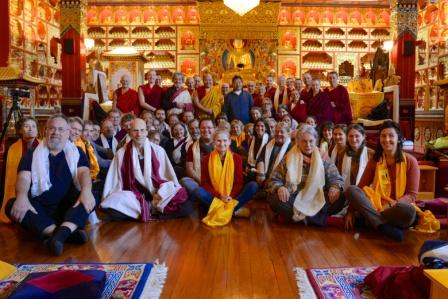
Samye Ling Shedra 2013: The Profound Inner Principles
In the fifth year of the Samye Ling Shedra studies, Drupon Rinpoche explains the Third Karmapa’s Profound Inner Principles. Rinpoche decided to take a closer and in-depth look at the first five chapters, rather than rushing through the text. His explanations focus on where we are at in our own spiritual development and how these teachings can be applied to our own mind. This is a Vajrayana treatise, but since we don’t have the Vajrayana view, we are not Vajrayana practitioners! We need to be very clear about this. Fooling ourselves blocks all future progress and could make the study of this text a cause for furthering our delusion.
The text is called ‘Profound’ because it can’t be understood by the conceptual mind and words alone can’t explain it. It elucidates the ‘Inner Principles’: the Vajra mind and Vajra body. Vajra means indestructible and refers to their changeless nature. How to understand this, given that our mind fluctuates continuously! Sometimes our thoughts are clear, sometimes they are not. Sometimes we’re happy, sometimes we’re not. Likewise, each part of our body changes, it grows, gets fat, thin, old, bald. However, since these principles are the inner nature of the mind and body, they have to be connected to our own mind and body. And this is where we need to start our examination, with what we can understand. Coming to know this better, the inner will show itself.
The first chapter focuses on the mind, on how delusion develops.
To help us apply it to our own minds, we have to examine our view. Rinpoche tells us to look at a cup and ask ourselves: How does it exist? What exists? How is this made by our mind when it clearly states on the cup it is made in China? As long as, within ourselves, we have the belief that the cup exists, meditating on emptiness will never bring result. It makes meditation powerless. To study our mind, we need to come to know mind and thought. We need to rely on and stay with a genuine Lama until realisation dawns. Through continuously studying with the Lama and contemplating those teachings, we can come to see that it is mind that creates samsara and nirvana. We need to find the mind before we can come to understand the play of the mind. Knowing this is the quintessential point of all Dharma. Presently how we see mind is mistaken, our mind changes all the time, how could that be the cause of nirvana!?
With such food for thought we move into the following chapters which focus on the body: how the body develops, its channels, winds and drops. Once more we are reminded that this is a Vajrayana text and we need to be clear about what that means. If we still see our body as one solid I-dentity, we might start to believe that within this body are channels, winds and drops. This is a view of delusion on top of delusion! With the right understanding however, the practice of the channels, winds and drops are the very remedy for our delusion, our ego clinging.
It is therefore vital that we check how we perceive our body. Do we take it to be solid, to be ‘me’? Dharma helps us to open this up. Teachings on the 5 aggregates, 12 ayatanas, 72000 channels and so on, help us to step away from seeing the body to be a singular unit we call ‘I’. Where exactly amongst the 5 aggregates, the many channels and winds etc, is the ‘I’?
Or we learn, for example, about the central channel. We mustn't just stick with the words and nod in agreement. Reflecting it back to the mind, it becomes shiné. We hear it has a shape, a colour, yet it has no substantiality. How can that be? Musing over it in this way, we can come to know emptiness. But emptiness has no shape, no colour, it isn’t a tube and of the colour blue! We need to resolve that the hollow tube and the colour are pointers towards what emptiness truly is. Meditating on the central channel is meditating on a symbol. In that way, the truth can come to be known. Otherwise, the central channel remains something physical, but then we die! If the central channel (together with the left and right channel) is the basis for the path and enlightenment, we would lose it all at the time of death. Over and over again, Rinpoche stresses that, in this fashion, we really need to turn everything upside down and inside out. With every new topic, we are implored to reflect them back onto our own mind and challenge its current view. The text is there for all to read, but these instructions really do bring it to life and into our lives!
We are totally humbled by the incredible kindness of Drupon Rinpoche and the preciousness of his teachings.
Summary by Inge Derijck.