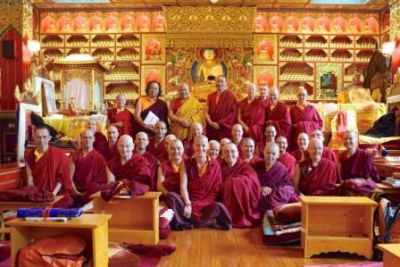
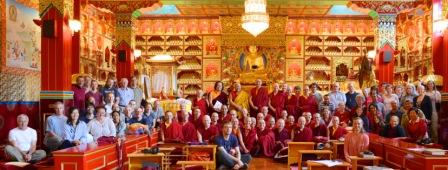
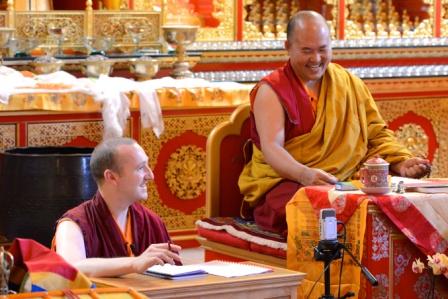
Training in the Three Levels of Commitments at Samye Ling
Jamgon Kongtrul's Treasury of Knowledge in ten books stands out as a unique, encyclopaedic masterpiece embodying the entire range of Buddhist teachings as it was preserved in Tibet. The text that Rinpoche taught at Samye Ling this year is the fifth book of that work and is considered by many scholars to be its heart. Jamgon Kongtrul explains the complete code of personal liberation as it applies to both monastic and lay persons, the precepts for those aspiring to the life of a bodhisattva, and the exceptional pledges for practitioners on the tantric path of pure perception.
The text is divided into four main sections: firstly, the Qualities of the Spiritual Teacher and Student, followed by a section on each of the three levels of commitments: The Vows of Personal Liberation, The Commitments of Awakening Mind and The Vows and Pledges of Secret Mantra. Drupon Rinpoche taught the first two and a large part of the third sections, spending longest on those key areas that he felt were most important for those attending. He also taught a further session each day for the ordained monks and nuns.
Rinpoche began by reminding us that the Dharma teaches that suffering is caused by the kleshas, and that by identifying the kleshas and then working to clear them away, temporary and ultimate happiness is attained. The Dharma can be seen to have two main aspects: the Dharma of scripture or doctrine, and the Dharma of realisation. Through studying the doctrine of Dharma as found in the Three Baskets, we can identify the kleshas, and having done so we can engage in the Three Trainings (Dharma of realisation) in order to clear them away. The three levels of commitments or vows are part of these Three Trainings. What is very important to understand, Rinpoche said, is that these commitments are not 'rules', but trainings that clear away the kleshas and suffering and bring about happiness.
Rinpoche emphasised that of key importance is our view, because it is only through the view (and not through meditation and conduct alone) that we can come to have real confidence in Dharma. The view enables us to see for ourselves just how the Dharma of scripture and realisation remedy the kleshas, freeing us of suffering and bringing happiness. This is not easy. In order for this to occur we must rely unerringly on a genuine guide. This is why this text begins with discussing the qualities of a genuine guide, and what it means for a suitable disciple to go about relying correctly on such a teacher. We often think that practice and retreat is the most important, but at the start it is actually far more important to rely upon and receive instruction from a genuine Lama, one who will help us develop the correct way of thinking so that we can then practice effectively.
Qualities of the Spiritual Teacher and Student
The different vehicles of buddhadharma each have their corresponding levels of commitments and way of perceiving and relating to the spiritual master: the monastic preceptor of the Hinayana, the bodhisattva instructor or spiritual friend of the Mahayana, and the vajra master and Lama of the Vajrayana. The text outlines the qualities that each of these needs to have in order to be considered qualified. One master can assume all the various roles of teachers as long as he or she meets all of the requirements for each type of teacher as specified in each system. To help the aspirant choose a suitable teacher and avoid a bad one, Kongtrul outlines the knowledge and virtues to look for in a teacher and warns of possible faults.
In relation to this, Drupon Rinpoche said:
"Who we rely upon as our Lama is so, so important. This is what makes it possible for us to become good dharma practitioners. What needs to be known will become known by having a good Lama."
He added however, that if we don't have a firm conviction in the existence of past and future lives, in the unerring quality of cause and effect and in the sufferings of samsara, then instead of seeing the Lama as someone capable of guiding us to ultimate freedom and happiness, we will regard them as a mere ordinary 'teacher'.
"In order to attain enlightenment, we need to purify our negativities and gather the accumulations. For this there is no other way than to rely on a spiritual guide. We need to know how liberation is attained and what it means – for this we need someone who knows, who has experience and can show us. If they have experience, this is what we will gain; our success in Dharma depends entirely upon the Lama… Nothing is more important than this. Without this, we can practice our whole life and not gain experience in Dharma. If we believe in past and future lives we will see the importance of this. If we don't rely on a genuine Lama, we will have an empty and wasted precious human life."
The text outlines four types of spiritual guide: the ordinary human being, a bodhisattva, a nirmanakaya and a sambhogakaya. Rinpoche pointed out that these four are not to be viewed from their own side, but in terms of our own level of perception. How we see the Lama corresponds to – and is determined by – how much faith we have and the degree to which we have purified our obscurations and gathered the accumulations. Our present times are often described as being 'a degenerate age'; and one way of looking at this is that it is very difficult for us to perceive the kind of qualities a Lama needs to have, as outlined in the text. This is especially so when it comes to perceiving the qualities of a bodhisattva, a nirmanakaya or a sambhogakaya. How then are we supposed to determine who is a genuine Lama with all the qualities, and who isn't? Rinpoche said that the qualities described in this text can be condensed into two very important ones: being knowledgeable in Mahayana and having a kind mind. If a Lama doesn't possess at least these two then we will not benefit from their guidance. It is not that the Lama needs a famous name or title, but that they possess knowledge and bodhicitta.
When it comes to the qualities of the disciple, Rinpoche highlighted three very important qualities that we need to have, as stated in the text:
"The individual who is impartial, intelligent and persevering is referred to as a suitable vessel."
Rinpoche explained that this means that we need to be straightforward and honest, not holding strongly to our fixed way of seeing things. We need to have prajna, and to be capable of striving and diligence. In particular, when it comes to Vajrayana we need to have faith and respect. If we have faith and confidence then the three qualities of impartiality, intelligence and perseverance can follow naturally.
We then need to actually rely on the Lama correctly. Again, faith here is essential, as it is only through faith that we may actually see the qualities of the Lama and become able to rely on their guidance. Without faith, even an exceptional Lama will appear ordinary. Such faith needs also to be accompanied by an intelligent ability to see and understand exactly how the Lama is helping us, and what it means to 'be helped'. If we don't have this understanding, then we may mistakenly believe that such help is just for the happiness, health and well-being of this life, rather than for the ultimate liberation of buddhahood. Therefore, if we can understand correctly and have the faith, then we will see why we need to rely on the Lama with the correct attitude and behaviour.
Rinpoche explained how, of all the different ways a genuine disciple can attend a genuine Lama, the best is to receive the instructions with joy and to study, contemplate and then meditate. Why is this so? A genuine Lama wishes only to benefit beings, to help them free themselves from suffering and attain buddhahood. The only way we can do this is through hearing and studying the dharma and instructions, then contemplating the meaning within our own being, and finally meditating upon our subsequent understanding. Disciples who act in such a way are able to free themselves from suffering, thus fulfilling the innermost wishes of their Lama. Rinpoche added that although this represents the highest service, 'outer' service such as making offerings, showing reverence and so forth are also very important, not because the Lama needs them, but because they reflect the inner attitude of cherishing the dharma that we need to cultivate.
The Three Ethics
Jamgon Kongtrul's text then presents in detail the three levels of ethics of the buddhist path: those of personal liberation, those of the awakening mind and those of secret mantra. Rinpoche taught that when we enter the buddhist path, we begin to learn about ethics. For many people, not really knowing Dharma means that they think of the vows as sets of 'rules', lists of 'dos' and 'don'ts' that must be followed. This is mistakenly placing too much emphasis on the external appearance of things. Rinpoche said that we need to see these commitments in a way similar to a sick person being given medications. All the different vows and so on are like the various medicines that attack the illness from different sides. A skilled doctor gives the correct medicine at the correct time, helping the patient progress to full health. We should understand the vows in terms of our own mind, which is 'sick' with the kleshas, the very cause of suffering in samsara. The various levels of ethics were taught by the Buddha because he saw that certain individuals needed certain things in order to help them remedy the kleshas and thus make progress on the path to buddhahood.
Rinpoche said that we need to understand that the different vows are not separate or distinct from each other – as we progress and move from one level of vows to another, the higher levels naturally include the lower. It is actually a progression of mind. Many people don't like the idea of being a monk or nun, but like the idea of the bodhisattva vows, and even more so, the commitments of secret mantra, seeing them as 'easier'. In fact, the higher the vows the more difficult they are to keep, precisely because the more advanced they become the more concerned they are with an increasingly refined and advanced view. All the various vows are actually the same practice, performed by the same mind, just at different stages of development.
The Vows of Personal Liberation
The vows of personal liberation, which embody the way of renunciation of the Hinayana, serve as the means for securing personal freedom from the cycle of existence by renouncing the causes of suffering. Its precepts are mainly concerned with the physical aspect of existence.
What is the very basis for the vows of personal liberation? The text states:
"Concern for personal peace motivated by renunciation"
Rinpoche explained how renunciation is the root of the Hinayana and the very basis for all that comes after it. Therefore there is no way to practice the Mahayana or Vajrayana without renunciation: seeing the six realms as nothing but suffering and wanting to be free.
"Most of us have taken vows of some kind and have received empowerments. That means that the most important questions we should be asking ourselves as we study the text are: 'Have I taken vows and what exactly are they? What exactly am I doing and where will this lead me?' Out of all such questions, the one we often forget is the most crucial: Why? If we don't repeatedly check why we are doing what we are doing, we may simply be buddhists in appearance only and not actually be on a path to personal liberation."
For us, "Concern for personal peace [alone]" is more likely to be the reason we entered the Dharma and practice the vows, meditate and so on. This is the attitude of just wanting some freedom from anxiety and fear, wishing for happiness, calmness, or security for ourselves in this life. Or are we more concerned with achieving an excellent rebirth in a higher realm in our next life? Taking vows motivated by either of these two attitudes does not constitute a path of personal liberation. So we need "an intention to emerge from all cyclic existence" – this is why, in the path of Dharma we begin with the 'four thoughts that turn the mind' and, having developed such an intention, we progress to taking refuge and the vows of personal liberation. So it is very, very important, Rinpoche said, to look at these three – what is seeking freedom from fear? What is aspiring to a future excellence? What is seeking liberation from cyclic existence? We need to examine our motivation closely so that the virtue we strive for actually brings the result that we seek.
Next the text defines what the vows of personal liberation actually are: "…to forsake both injury to others and its basis". Rinpoche said that this is extremely important to know. Committing to not harming others (through the seven unwholesome deeds of body and speech) is the very basis of the buddhist path.
"Ask yourself, 'is it harmful or beneficial for me to refrain from harming others? Is it harmful or beneficial for me to refrain from killing people? Is it good for me not to steal from others?' Weigh up the pros and cons – is killing people, stealing, lying and so on a good thing? How are people who do such things regarded by others? 'Genyen' (the lay vows) means 'moving closer to what is good' – but when most people hear about vows they want to run away!"
Rinpoche emphasised that we need to become 'followers through intelligence' – seeing the reasons why we don't harm others, why something is positive and another negative. The Buddha taught that negative actions are those motivated by the kleshas of attachment, aversion and ignorance and that result in suffering. However, at the beginning it is difficult to remedy the kleshas directly and so, although the aim of the personal liberation vows appears to be restraint from unwholesome behaviour of body and speech, their implicit aim is to overcome the kleshas. Rinpoche gave a commentary to Kongtrul's explanations of the various classes of personal liberation: the precepts of the purificatory fast and the genyen vows of the layperson, the getsul vows of male and female novices, the female postulant, and the gelong vows. Rinpoche said that the full nun's vows were not included in Kongtrul's text, as the full ordination of nuns was never introduced into Tibet.
The Commitments of the Mind of Awakening
What determines whether the vows taken are those of personal liberation or of the mind of awakening? Rinpoche repeatedly asked us not to get caught in the externals of such a teaching. As one progresses on the path, there is a corresponding development in our view and motivation. It is this inner motivation and view that determines the level of vow we are actually taking and practising. Once we have developed the attitude that samsara is nothing but suffering and have the motivation to be free of it, we then progress on the path to seeing that our own liberation is not enough, for all beings suffer equally in samsara. We feel, "all beings need to be free from suffering!" And so we move from the personal liberation vows of simply not harming others, to actively wishing to help them. This is not easy; it is embodied in the feeling, 'whatever happens to me is fine, as long as they are OK'. This is the main difference between Hinayana and Mahayana – the latter concerns caring more for others than for oneself. This is the basis for the mind of awakening commitments. Therefore, the ethics of awakening mind, the path of the bodhisattva, are chiefly concerned with mental disposition.
In the text, Jamgon Kongtrul primarily explains the commitments of the bodhisattva under seven main headings. As these commitments are centered on the awakening mind (bodhicitta) itself, Kongtrul first examines the causes, nature, varieties (the aspiring and venturing, the relative and ultimate), and so forth of the awakening mind, before the training is described. The focus of these commitments is the training to be followed on the bodhisattva path.
The primary or actual cause for bodhicitta to arise and for buddhahood to be attained is the nature of mind itself, the buddhanature. The secondary cause is relative bodhicitta, which acts as a condition to make the primary cause, the nature of mind, evident. Rinpoche taught that the actual cause of the nature of mind, ultimate bodhicitta is not so easy for beginners, and so we engage in the practices and trainings of relative bodhicitta to reveal it. The essence of the bodhisattva commitments is to forsake unwholesome deeds of body, speech and mind, while being motivated by the intention to attain complete awakening for the sake of others. For this Rinpoche said that two essential qualities are needed: compassion focussed on beings and wisdom focussed on enlightenment.
The actual cultivation of the awakening mind, attended by specific points of training, is presented from the perspective of the lineage of the profound view, which was inspired by Manjushri and transmitted to Nagarjuna, Shantideva, and others, and the magnificent deeds (vast activity) lineage, which was inspired by Maitreya and transmitted to Asanga, Chandragomin, Atisha, and others.
These two systems are basically the same, and certain aspects of training are common to both. The common training includes the three forms of ethics for the bodhisattva, which are to shun non-virtue, acquire wholesome qualities, and work for the benefit of others, and the implementation of the six perfections: generosity, ethics, patience, effort, meditation, and wisdom.
Rinpoche concluded the teachings in this, the fourth of the seven points. He finished by encouraging those that felt like taking vows to do so. He said that even one vow such as not to kill brings great benefit. Having received the teachings on the vows, some individuals made commitments to take getsul and gelong ordinations. Rinpoche himself gave lay vows to many of the lay practitioners.
The teachings were translated by Karma Kunga, and were transmitted live via a private connection to those in the four year retreat. During the course and for an auspicious future tendril, Rinpoche bestowed the lung for the complete works of Gampopa.
Summary by Peter Hutchinson.