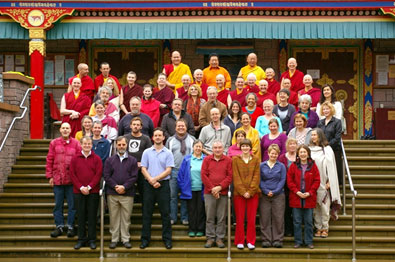
Samye Ling Shedra 2012: The Treatise on the Ultimate Continuum
Drupon Rinpoche has just completed teaching this year's shedra text: Mahayanauttaratantrashastra (Mahayana Treatise on the Ultimate Continuum) by Arya Maitreya. This text teaches the ultimate step in the understanding of the Middle Way and is famous as the "bridge between sutra and tantra". It is one of the three great texts that are of key importance to the Kagyu lineage, the other two being the Zabmo Nangdon (Profound Inner Meaning) and the Hevajra Tantra, which will be taught in years 5 and 6 of the shedra respectively.
Building upon the three previous years of study on the Middle Way view of emptiness, Rinpoche explained how these Ultimate Continuum teachings offer a 'next step' in one's evolving understanding of the view, while at the same time being both inseparable from and complementary to the Second Turning.
At the heart of this text are the profound teachings on the tathagatagarbha or 'buddha nature' and how it is present within all sentient beings. As in the previous years of this course, Drupon Rinpoche repeatedly emphasised that this understanding must be 'brought home' in one's own experience, rather than being left as mere intellectual understanding. He explained how it is absolutely essential to regard the three excellences of study, reflection and meditation as a process, where one level of understanding leads into the next.
"All of these six years of study are about the mind. The first three years are about the empty nature, the last three about the clarity aspect. A thorough understanding of mind and how it is, is the proper outcome of these studies. Knowing the texts and concepts doesn't mean we have finished our training; you should use your studies to understand the mind better, so apply them to your mind."
Through sincerely studying and then reflecting upon these teachings in relation to one's own experience, one can come to an understanding that buddha is to be found nowhere apart from one's own mind. This provides the essential basis for an authentic meditation practice and in particular, the profound methods of vajrayana: the development stage of visualising deities and the completion stage practices such as the Six Yogas of Naropa, Mahamudra and Dzogchen.
Around 50 people attended, some travelling from as far away as South Africa and most of whom had studied the previous years' topics on the Middle Way. As usual there were two teaching sessions a day which were translated by Ken Holmes, and there were two exams. The first of these was held near the beginning of this year's course and covering last year's text, the Abhisamayalankara (The Ornament of Clear Realisation) by Arya Maitreya. The second exam, covering the first two weeks teachings on this year's text, was held during the second half of the course.
What many participants found particularly beneficial is how Rinpoche combined the theoretical teachings with practical advice on how to apply them to one's own mind. This led many to seek Rinpoche’s advice and he accordingly granted a large number of individual interviews during the breaks. Generally there seemed to be a growing appreciation among students of how the buddha dharma 'fits together', as well as a deepening commitment to integrating the teachings into their experience.
Summary by Peter Hutchinson.