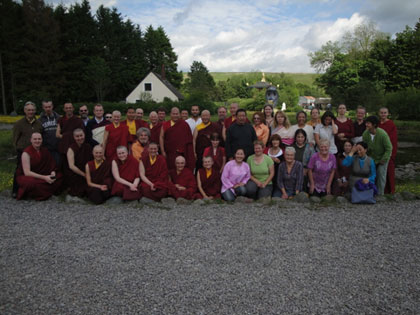
Samye Ling Shedra 2010: The Root Stanzas of the Middle Way
Drupon Rinpoche returned to Samye Ling for the second year of the shedra teachings. This year he focused on Arya Nagarjuna's root text Mulamadhyamakakarika (The Root Stanzas of the Middle Way called Supreme Wisdom or The Fundamental Wisdom of the Middle Way).
This is the second of the three texts on Middle Way philosophy that make up the first three years of the curriculum. The teachings were translated by Ken Holmes and were attended by a group of over 50 students, who came from all corners of the world. As with the previous year, the teachings were divided into two separate fortnights, with two two-hour teaching sessions (morning and afternoon). There were two exams this year; the first examining Chandrakirti's Madhyamakavatara (Entering the Middle Way, the previous year’s text), and the second testing the students on the first part of this year’s course.
After last year's eye opener of Chandrakirti's Entering the Middle Way, we all flocked back to Samye Ling like swallows yearning and searching for the warmth of the sun. It was wonderful to have Drupon Rinpoche amongst us again, willing to share his genuine knowledge. There was excitement and trepidation in the air, with the latter easing off considerably after the exam.
Study groups formed quickly, filling the dining room, café and library. In this way, we bent our heads over Nagarjuna’s root verses, of which we got a taste last year through studying Chandrakirti’s commentary. Various terms that made our heads spin then started to sound more familiar.
Day by day, Drupon Rinpoche took us with great care and detail over the various reasonings presented in each chapter, welcoming us further into the Middle Way philosophy. We examine the reasonings and refutations in order to deepen our conceptual understanding of how the true nature is beyond all extremes and concepts. However, Rinpoche is equally determined to guide us on how to put this into practice. He said how we need to let our coarse way of viewing 'the things we call reality', flow into a much more subtle form of investigation. We look at a beautiful flower. Without investigation (i.e. at the level of relative truth), it is and will remain to be what we perceive it to be: a beautiful flower. However, what is it that sees this flower? Is it the eyes, the eye consciousness? Where and how do they meet with the flower? Which of the three comes first? If the flower is the cause for it to be perceived, could it then exist at the same time as the result?
Or let's take 'time' which Nagarjuna invites us to investigate. We all see the seasons change and the years go by. We arrange to meet someone at a certain time and, depending on who it is, we can find ourselves counting the seconds. Admittedly, it seems rather obvious in our relative reality that time exists. But does it stand up to reasoning? Through his questioning, Nagarjuna throws in a few tremors. Where exactly does the past finish, the present occur and the future start? As we watch the clock ticking away, where exactly is the present (or time for that matter)? Are past, present and future dependent upon each other or do they exist independently? Whatever our answer, as long as it comes from a belief that time is real, it will never stand up to in-depth scrutiny. Isn't it so that, apart from the realm of thought, past, present and future cannot possibly be found?
Yes, it can quite easily get a little confusing. But then Rinpoche reminds us that it is precisely through our doubts that the first cracks can start to occur in our solid view of reality. It is where transformation takes place. If we diligently apply ourselves to Nagarjuna's methods of investigating our own mind, these tremors can become the earthquake to collapse our solid notions, thus freeing us of all but the true essence of Dharma.
For now, as we move from reasoning to reasoning, from chapter 1 to chapter 27, we find ourselves revaluating misconceptions such as self and phenomena, the elements, samsara, nirvana, suffering, coming and going.
And as I walk home, I'm left wondering whether the movement was in the step I've just taken, the one yet to come or whether it's there at all.
Summary by Inge Derijck.