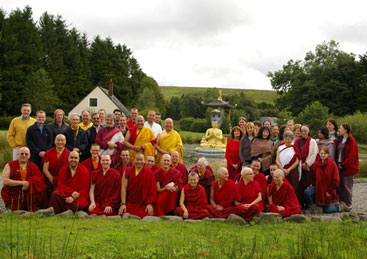
Samye Ling Shedra 2009: Penetrating the Middle Way
In 2008, at the invitation of Akong Rinpoche and Lama Yeshe Rinpoche, Drupon Rinpoche made his first visit to Samye Ling. It was at this time that he introduced the Shedra Studies Course that would begin the following year, and that would serve as a precursor to the future Samye College (currently under construction at Samye Ling). At that time, he explained his intention:
"The teachings concerning direct realisation require (meditation) practice for them to be apprehended properly and that, in turn, is necessarily founded in the theoretical teachings. The theoretical content itself requires proper explanation and proper study. Thus, being the root of all, explanations and study are of great importance, however one considers the matter."
"There are six excellent treatises which make exceptionally clear every meaning of all the incalculable teachings of the Buddha and the shastras. Someone able to receive these teachings and then to study them excellently will understand the most part of the root essence of Buddhadharma."
Drupon Rinpoche
The study of these treatises began in 2009 with the Madhyamakavatara (Penetrating the Middle Way), a shastra by Chandrakirti (c.600–650 CE) on the Middle Way doctrine of voidness or emptiness. A commentary on Nagarjuna's Mulamadhyamakakarika (the subject of the 2010 shedra course), the Madhyamakavatara is comprised of eleven chapters, addressing the ten paramitas and the 10 bhumis traversed by bodhisattvas on the path to buddhahood. In particular, the text lays out different buddhist and non-buddhist views on the nature of reality, in order that the Prasangika Middle Way reasonings (of which Chandrakirti was a major proponent) can be applied. A trademark of the Prasangika approach is that it does not hold to any particular view itself; rather, it uses a system of reasoning to highlight the flaws inherent within any firmly held position. Such positions can typically tend towards things being truly existent or permanent, or towards non-existence, nothingness. The Prasangikas will often use the very arguments put forth by these systems to refute them.
As Rinpoche was keen to point out – all of this has a very real and important purpose. The text and its reasonings are not merely to be learned, but to be used as tools to be applied to our own views.
Rinpoche emphasised that we need to examine very carefully exactly where our own beliefs and convictions about reality lie. We must each ask ourselves, “Where do I stand in relation to these different views that are being refuted?” Once we know this, then we can use the Prasangika reasonings to question our accepted and entrenched ways of seeing things. Such self-analysis can serve as an excellent basis for meditation, and Rinpoche was emphatic about the fact that for the majority of practitioners, meditation without a good understanding will not lead to profound or lasting results.
The first year course was divided into two separate fortnights, with a written exam at the beginning of the second half. In addition, twice a day (at the beginning of the morning and afternoon teaching sessions) a student would be selected to give an oral presentation on the previous day’s teachings. This proved challenging for some, for whom Rinpoche’s daily ritual of selecting candidates was a nail-biting experience! It did however lead to people applying themselves assiduously to study; a fact substantiated by the huddles of students that could be spotted around Samye Ling, diligently revising their verses. And while this encounter with the Middle Way may have presented a steep learning curve, this was accompanied by a deep sense of gratitude to Drupon Rinpoche, to the lineage and to the buddha dharma itself. After all, what was being transmitted had one single purpose: to bring about a radical reappraisal of how we view reality; a tectonic shift that can ultimately liberate all beings from suffering.
Summary by Peter Hutchinson.