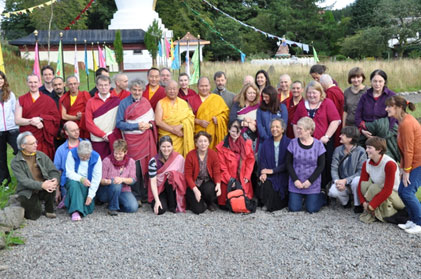
Samye Ling Shedra 2011: The Ornament of Clear Realisation
The Abhisamayalankara (The Ornament of Clear Realisation) by Arya Maitreya was the last of the three Middle Way texts that Rinpoche taught as part of the six year shedra program. Ken Holmes translated for the international group of students, who as usual sat two exams during the month-long course.
Unlike the previous two Middle Way texts, this particular shastra doesn't have a lot of reasoning. It is a fine analysis of the path in terms of a remedial process: what is to be abandoned, the remedy and the realisation for all of the stages.
While prajna paramita is not something readily grasped, Rinpoche said that an understanding of this text would help in developing reason and clarity of mind and ultimately in attaining the ‘knowledge of all aspects’, the actual knowledge of the true nature of all things. However, being new to this text, we are just meeting the terms for the first time.
The eight chapters of the Abhisamayalankara present eight areas of knowledge in which the real meaning of prajna paramita is contained. The first three chapters present what is to be known and realised on the path to Buddhahood; the following four, the four kinds of training for gaining that realisation; and finally the last chapter concerns the fruition.
Rinpoche explained how the starting point for understanding this text lies in the distinction between the concepts of object and subject and how these ‘two’ should be known as being beyond duality: the object being the true nature and the subject the degree to which that very nature is understood.
Exploring the four truths and its sixteen aspects throughout the different stages, we are shown what is to be abandoned and adopted. Rinpoche stressed how we need to relate these truths to our own being; after all, we are all sentient beings and therefore have the seed of bodhicitta within us.
Through studying these, we have to ask ourselves: "How is my own mind?" and "How many truly virtuous thoughts appear?" This text shows us all the faults and their remedies, and so we are implored to minutely examine our own minds, find the faults and then diligently apply the remedies.
We are encouraged to study, and the technique to study is to relax. It means taking each idea in turn and to examine it slowly and carefully, trying to understand it and apply it to our own being. It is a form of shiné, since shiné means one-pointedly dwelling on virtue. It also becomes excellent lhaktong since the subject is about the true nature. Study and analyses properly done will bring about peace and mastery, which tames our minds. Just learning the (many!) lists is missing the point; it's just a busy mind. We need to use those lists to turn the mind within, for it to discover and understand itself.
In this way, Rinpoche's explanation of the words of the text was continuously interwoven with very hands-on practice advice, moistening and enriching our learning experience.
The Abhisamayalankara thus describes in great detail the Mahayana journey of the five phases of the path. It clarifies the manner in which practitioners move from the path of accumulation and integration, to becoming bodhisattvas at the moment of the path of insight (first bhumi). How they, from the second bhumi onwards, embark upon the path of meditation, traversing through the different stages until they reach the path of no more learning at the conclusion of the tenth bhumi.
With the teachings drawing to a close after our month together, the road ahead – now clearly mapped out – looks rather long indeed!
Summary by Inge Derijck.