Teachings in Halifax, Canada
Rinpoche was invited to come to Halifax by the Shambala community.
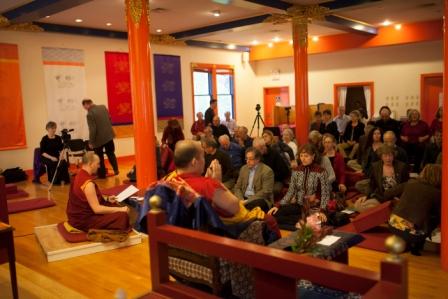
Over the first days he gave three sessions of teaching on creation stage practice. In the first session he emphasised the importance of the view, and taught that the level of our practice is determined by our view and not by the sadhana or practice material we are working with, and that for there to be authentic creation stage practice there has to be an understanding of the view of that level of practice. He stressed that in order for there to be an understanding of the view one has to learn and study; the reasons why that is so necessary formed a major part of the first session.
In the second session Rinpoche focused on the clarity of form aspect of creation stage. He gave instructions for how to bring about clear creation stage practice as it was traditionally taught, based on a text called Notes on the Creation Stage. Rinpoche also gave an overview of creation stage for each of the different levels of Tantra – Kriya, Charya, Yoga, and Anutarrayoga. He taught that once we are totally adept at visualising the deity then we are ready to use a sadhana. Thus in the third session Rinpoche took us through the steps common to most sadhana practices and gave brief instructions for each of the main steps, starting with refuge and the generation of bodhichitta, then the gathering of the accumulations, and then the various processes of the actual practice of creating the deity through The Three Vajra Rituals, The Four Manifest Awakenings, and The Five Manifest Awakenings. Of these he concentrated on The Four Manifest Awakenings since he felt that this is the process that fits with the practices of the majority of the students there best.
Rinpoche’s style of teaching during these instructions was quite unique because he focused little on explaining the visualisations but more on pointing out the possible pitfalls and contradictions within our practice of creation stage.
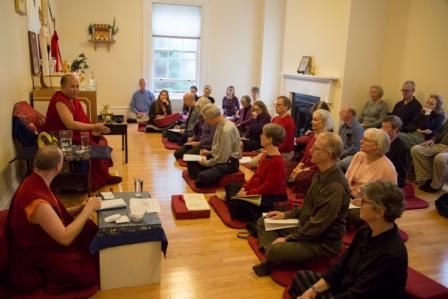
Each day of his visit Rinpoche met with different practice groups to answer their questions and give advice. Sometimes the questions were specific to the practice of the group sometimes they were more general.
The first day he met the Six Dharmas of Naropa practice group. To these practitioners he emphasised the need for stable creation stage practice as a prerequisite to this level of completion stage practice. He also spoke of the different styles of Six Dharma practice, the approach of Milarepa where the path of method (the Six Dharmas) is practised as a method to recognise the path of Liberation (Mahamudra); and the approach of Gampopa where first there is a recognition of the path of liberation and that forms the core of the practice of the path of method which is being used as a method to gain proficiency in Mahamudra rather than as a cause for obtaining the recognition of Mahamudra.
The next group he met was the Vajrayogini group. To this group he spoke about how whatever practice we do we must come to an understanding of how that practice contains all practices, how all are of a single key point. And how that if you understand one aspect of the practice that leads to an understanding of all aspects.
The next group he met was the Vajrakilaya group. To this group he taught a few general points for wrathful practices, such as how we come across phrases such as “Kill the enemies and those who harm the doctrine and sentient beings!” He explained how we should not misunderstand such words but should recognise that without the kleshas and ego-clinging there would never be any harm-doers, so the true harm-doers are the kleshas and ego-clinging, and so it is these that have to be destroyed and these are what the word “enemies” refer to.
The next group he met was the Chakrasamvara group. They asked questions about the meaning of the long and short mantras of Chakrasamvara and about the three mandalas. Rinpoche spoke a lot about the phrase “Not abandoning samsara” and how it does not mean just not giving up our worldly way of life, because if it did that would mean all worldly beings could be considered Vajrayana practitioners. This topic of not abandoning samsara became the main point of discussion and Rinpoche explained at length the level of understanding and insight one needs in order to be able to not abandon samsara.
The next group he met was the Four Session Guru Yoga group. The first point of discussion was based on three lines of the liturgy which spoke of the “Devotion of Mahamudra”. Rinpoche taught how usually we see our devotion in terms of “I have devotion for them” and that as long as we have that then we do not have Mahamudra devotion. In response to a question about lamas Rinpoche taught about the qualities that a lama has to have in order to be authentic. He spoke of two essential qualities: To be learned and compassionate. He said that even if the lama is compassionate if they are not learned then they will not know the different methods which suit the different aspirations and needs of the different kinds of students. If they are learned but lack compassion then they will not have the students' welfare as their principal concern but will use the students for their own personal gain; to increase their renown, to increase their wealth, to further their own institution etc.
Rinpoche also met with the Sadhaka contemplation group. He expressed his delight in hearing about how they meet weekly to contemplate and discuss the Dharma, and answered their questions.
Rinpoche met again with the Vajrayogini group and gave practical advice, as well as some history about the different aspects of the practice. The practical advice he gave was given in answer to a question about which points of the visualisation should be the main focus during the recitation. He taught that in his opinion the main focus should be the Hrih syllable, and he taught how to alternate our style of focus in a way that will increase our understanding and stability in meditation. Another of the principal points that Rinpoche made in this talk was how we could ask different lamas the same question and get different answers, and therefore it is essential that we have our own understanding so we can determine from which perspective the lama is teaching, and so that we are not forever having to abandon our present practice in order to adopt the “new” instructions that we hear.
On the ninth and final day of teachings Rinpoche was asked to talk about the Protector Principle and give some historical information about the Dharma Protectors related to the Shambala community.
The first point Rinpoche made was that just as we have the Sangha (in the Sutrayana presentation of the Three Jewels), we have the Dharma Protectors (in the Vajrayana presentation of the Three Roots) and they both perform the same function of helping us on the path. Not only that but just as we have the Sangha of noble beings and the Sangha of ordinary beings, we also have the wisdom protectors and the worldly protectors. It was through his teaching on the similarity between the Sangha and Dharma Protectors that Rinpoche conveyed the protector principle. He ended the talk by giving some historical accounts of Four-Arm Mahakala, and Gesar of Ling.
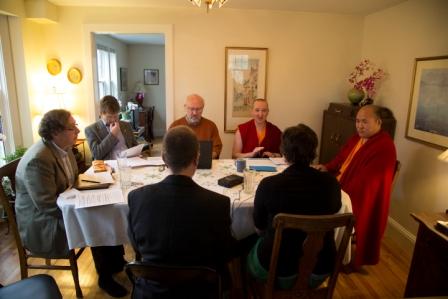
During his stay in Halifax Rinpoche met with the Nalanda Translation Committee several times to answer their questions about a doha of the previous Trungpa Rinpoche, and on a Sutra the committee are in the process of translating as part of the 84000 project.
Written by Kunga, who acted as interpreter for the duration of Rinpoche’s visit.